Joining MAVENs
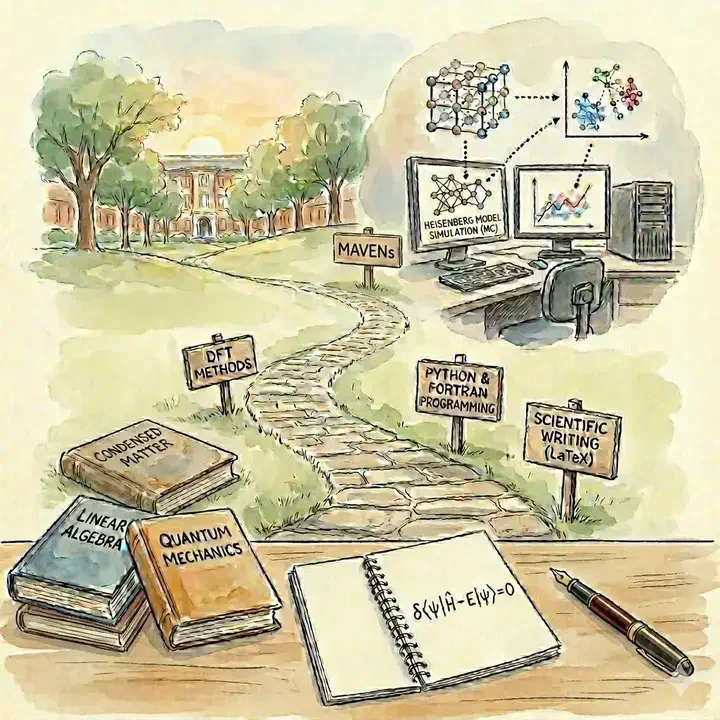
This page is for students considering a project or PhD with us. It covers what you would actually be doing, what you would come out with, and what we ask of you before applying. A separate guide for new members covers the practical side once you have joined.
What You Would Be Doing
Work in the group is computational. You would be running first-principles calculations, Monte Carlo simulations, or machine learning workflows on real materials problems — not toy systems. Specific topics span energy materials, quantum and spintronic systems, and ML-driven materials discovery; see the research pages for the full picture.
What this looks like day to day: reading papers, setting up and running calculations on our compute resources, debugging when they fail (they will), analysing output, writing up what you find, and discussing it with the group. You will spend more time thinking and reading than you might expect, and that is the point.
Research does not move in a straight line. You will spend stretches not knowing what to do next, calculations will break, and things you were sure of will turn out to be wrong. This is what research feels like from the inside, for everyone — it is not a sign that you are not cut out for it. What helps is reading more widely than your immediate problem, talking to senior students before bringing it to me, and letting a stuck problem sit overnight before deciding it is hopeless.
What You Would Gain
By the end of a project or PhD with us, you would have:
- Working knowledge of density functional theory, statistical methods, and where appropriate, machine learning — not as black boxes, but at the level where you understand what the methods can and cannot do
- Comfort with Linux, the command line, scripting in Python and Fortran, version control with Git, and scientific writing in LaTeX
- Experience presenting your work — in group meetings as a matter of course, and at conferences or workshops where the work and timing allow
- For PhD students and longer-running MSc projects: co-authorship on publications resulting from your work, under standard authorship norms
- A research portfolio you can point to — code, writeups, and ideally papers — when applying for the next step, whether that is graduate school, a postdoc, or industry
The skills are genuinely transferable. People who have worked in computational materials groups end up in academic research, semiconductor and materials companies, scientific software, and increasingly in ML-focused roles in industry.
Who We Are Looking For
A useful student in this group is not necessarily the one with the highest marks. The traits that matter more:
- Comfort with being confused, and persistence through it
- Curiosity about why something works, not only that it works
- Willingness to read difficult papers slowly rather than skim them
- Basic mathematical maturity — linear algebra, calculus, some quantum mechanics
- Some programming experience, in any language; you do not need to know Fortran or Python specifically before you arrive
If you do not have a strong background in condensed matter or computational methods, that is fine — most students do not, when they arrive. What matters is the willingness to build it.
What We Ask Before You Apply
Time commitment. Project students must join for a minimum of three semesters. I do not take students for a single semester — meaningful research is not possible on that timescale, and it is not fair to either of us to start something we cannot finish. If you are looking for a short project to fulfil a course requirement, this is not the right group.
PhD students are a full-time, multi-year commitment by definition.
Honest interest. Before you write to me, look at the research pages and at a couple of recent group publications. You do not need to understand everything in them — but you should be able to say, in your own words, what about the work draws you in. A request that could have been sent to any computational group tells me you have not thought about why this one.
How to Apply
Write to me with:
- A short note (a few paragraphs) on what you have done so far, what you are looking for, and what about the group’s work interests you
- Your CV and academic transcript
- For PhD applications: any prior research experience, publications or preprints if you have them, and your timeline
Contact details are on the contact page. I read every message, but I cannot always reply immediately — if you have not heard back in two weeks, a polite follow-up is welcome.
If we exchange a few emails and there seems to be a fit, the next step is usually a conversation — in person if you are at SRMIST, on video if not.
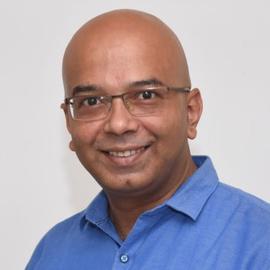
Rudra Banerjee
Assistant Professor, Computational Condensed Matter
Predicting how atomic-scale disorder and chemical complexity govern magnetic, catalytic, and quantum phenomena, from first principles.