Kohn-Sham Equations
The Hohenberg–Kohn theorems establish that the ground-state density \(\rho_0(\mathbf{r})\) uniquely determines all ground-state properties, and that the total energy \(E[\rho]\) is minimised by \(\rho_0\). However, they say nothing about how to compute the universal functional \(F[\rho]\), and in particular how to evaluate the kinetic energy \(T[\rho]\) as a functional of the density alone. As we saw with the Thomas–Fermi model in Chapter 1.6, attempts to write \(T\) purely in terms of \(\rho\) using a local UEG ansatz lead to qualitative failures: no molecular binding, wrong asymptotic decay, no shell structure.
The Kohn–Sham (KS) formalism, introduced by Walter Kohn and Lu Jeu Sham in 1965, provides an elegant and highly accurate solution: introduce a fictitious system of non-interacting electrons that, by construction, reproduces the exact ground-state density of the true interacting system. By reintroducing single-particle orbitals — but only as a computational device for the kinetic energy — KS theory salvages the rigour of the Hohenberg–Kohn theorems while sidestepping the local-functional pitfalls of Thomas–Fermi. The result is a set of effective single-particle equations — the Kohn–Sham equations — that are computationally feasible while remaining formally exact.
Decomposition of the Energy Functional
The key idea is to split the unknown universal functional \(F[\rho]\) into parts that can be handled accurately and a remainder that must be approximated:
where each term has a specific physical meaning:
-
\(T_s[\rho]\) is the kinetic energy of a fictitious non-interacting system with the same density \(\rho(\mathbf{r})\) as the real interacting system. Unlike the full kinetic energy \(T[\rho]\), this quantity can be computed exactly from the single-particle orbitals (see below).
-
\(E_{\mathrm{H}}[\rho]\) is the classical Hartree energy — the electrostatic self-energy of the electron charge distribution, treating it as a classical continuous fluid:
This is the dominant part of the electron–electron repulsion and is treated exactly.
- \(E_{\mathrm{xc}}[\rho]\) is the exchange-correlation (XC) energy. It collects everything that is missing from the above terms:
This includes the quantum exchange energy (the \(K_{ij}\) integrals introduced in Chapter 1.5.2), all Coulomb correlation effects beyond the Hartree level, and the correction to the kinetic energy from the interacting nature of the true system. \(E_{\mathrm{xc}}\) is the only term that must be approximated; its exact form is unknown.
- \(\int V_{\mathrm{ext}}(\mathbf{r}),\rho(\mathbf{r}),d\mathbf{r}\) is the interaction with the external potential (the nuclear attraction and any applied fields), treated exactly.
The Kohn–Sham ansatz reduces the DFT problem to finding a good approximation for \(E_{\mathrm{xc}}[\rho]\) — a functional of three-dimensional \(\rho\) alone — rather than solving the full \(3N\)-dimensional Schrödinger equation.
The Kohn–Sham Ansatz
The central assumption of the Kohn–Sham approach is:
There exists a system of non-interacting electrons — the KS reference system — whose ground-state density is identical to that of the true interacting system.
Non-interacting \(v\)-representability. This assumption is not trivially guaranteed. It requires that the interacting ground-state density \(\rho_0(\mathbf{r})\) can be reproduced as the ground-state density of some non-interacting system moving in a local effective potential \(V_{\rm eff}(\mathbf{r})\). Densities for which this holds are called non-interacting \(v\)-representable. While a general proof is lacking, no physically relevant counterexample has been found, and the assumption is accepted as holding for all practical ground-state densities encountered in electronic structure calculations. The Kohn–Sham equations derived below are exact under this assumption.
The density is represented in terms of Kohn–Sham orbitals \({\phi_i(\mathbf{r})}\):
The kinetic energy of the non-interacting reference system is then computed exactly from these orbitals:
This is the key advantage over orbital-free approaches like Thomas–Fermi: by working with orbitals we recover the exact non-interacting kinetic energy at the cost of introducing \(N\) single-particle functions.
Derivation of the Kohn–Sham Equations
We seek the set of orbitals \({\phi_i}\) that minimises the total KS energy functional \eqref{eq:KS-energy}, subject to the constraint that the orbitals remain orthonormal:
This is a constrained minimisation problem, which we solve using the method of Lagrange multipliers. We construct the Lagrangian:
where \(\epsilon_{ij}\) are the Lagrange multipliers enforcing orthonormality. Taking the functional derivative with respect to \(\phi_i^*(\mathbf{r})\) and setting it to zero yields:
Applying the chain rule to the left-hand side — \(T_s\) is an explicit functional of the orbitals, while \(E_{\rm H}\), \(E_{\rm xc}\), and \(E_{\rm ext}\) depend on the orbitals only through the density \(\rho(\mathbf{r}‘) = \sum_j|\phi_j(\mathbf{r}’)|^2\):
Evaluating the individual derivatives:
- \(\frac{\delta T_s}{\delta \phi_i^(\mathbf{r})} = -\frac{1}{2}\nabla^2 \phi_i(\mathbf{r})\) — standard variation of \(T_s = -\tfrac{1}{2}\sum_j \int \phi_j^\nabla^2\phi_j,d\mathbf{r}\).
- \(\frac{\delta \rho(\mathbf{r}‘)}{\delta \phi_i^(\mathbf{r})} = \phi_i(\mathbf{r}’)\delta(\mathbf{r}-\mathbf{r}‘)\) — from \(\rho(\mathbf{r}’) = \sum_j |\phi_j(\mathbf{r}‘)|^2\), differentiating with respect to \(\phi_i^(\mathbf{r})\) picks out the \(j = i\) term and localises it at \(\mathbf{r}’ = \mathbf{r}\).
- \(\frac{\delta E_{\mathrm{ext}}}{\delta \rho(\mathbf{r})} = V_{\mathrm{ext}}(\mathbf{r})\) — from \(E_{\rm ext} = \int V_{\rm ext}\rho,d\mathbf{r}\).
- \(\frac{\delta E_{\mathrm{H}}}{\delta \rho(\mathbf{r})} = \int \frac{\rho(\mathbf{r}‘)}{|\mathbf{r}-\mathbf{r}’|},d\mathbf{r}’ \equiv V_{\mathrm{H}}(\mathbf{r})\) — differentiating the symmetric double integral and exploiting symmetry to cancel the factor \(\tfrac{1}{2}\).
- \(\frac{\delta E_{\mathrm{xc}}}{\delta \rho(\mathbf{r})} \equiv V_{\mathrm{xc}}(\mathbf{r})\) — by definition; this is the exchange-correlation potential whose explicit form is the subject of Chapter 4.
This defines the Kohn–Sham effective potential:
The minimisation condition becomes:
Because the Hamiltonian \(\hat{h}{\mathrm{KS}} = -\frac{1}{2}\nabla^2 + V{\mathrm{eff}}\) is Hermitian, the matrix of Lagrange multipliers \(\epsilon_{ij}\) is also Hermitian and can be diagonalised by a unitary transformation of the orbitals. This transformation leaves the total density \(\rho(\mathbf{r})\) unchanged. In this diagonal representation, we obtain the canonical Kohn–Sham equations:
These are single-particle Schrödinger-like equations. The eigenvalues \(\epsilon_i\) are the Kohn–Sham orbital energies.
The Self-Consistent Field (SCF) Cycle
The Kohn–Sham equations are non-linear: the effective potential \(V_{\mathrm{eff}}(\mathbf{r})\) depends on \(V_{\mathrm{H}}\) and \(V_{\mathrm{xc}}\), which in turn depend on the density \(\rho(\mathbf{r})\), which is computed from the orbitals \(\phi_i(\mathbf{r})\) that are the solutions to the KS equations themselves. There is no way to write down the solution in closed form: the equations must be solved self-consistently through iteration.
SCF vs. Iterative Methods: Two Different Iterations
The term “iterative” is often used loosely in DFT, but two fundamentally different iterative procedures are involved, and distinguishing them is essential for understanding how a calculation actually runs.
The SCF cycle is a fixed-point iteration. The mathematical problem is to find a density \(\rho^*(\mathbf{r})\) such that
\[ \rho^* = F[\rho^*], \qquad F[\rho] \equiv \sum_i |\phi_i\rho|^2, \]
where the right-hand side is constructed by (i) building \(V_{\rm eff}[\rho]\), (ii) solving the KS equations for the orbitals, and (iii) summing the orbital densities. The map \(F\) is non-linear in \(\rho\) — \(V_{\rm H}\) and \(V_{\rm xc}\) are non-linear functionals of the density — so the fixed point cannot be found by direct linear algebra. Instead it is found by iteration: \(\rho^{(n+1)} = F[\rho^{(n)}]\), possibly with mixing to ensure convergence (Chapter 8). The number of SCF iterations is typically 20–80 for a converged calculation.
The eigenvalue solver is a linear iterative method. Inside step (ii) of each SCF iteration, the linear problem \[ \hat{h}{\rm KS},\phi_i = \epsilon_i,\phi_i, \qquad \hat{h}{\rm KS} = -\tfrac{1}{2}\nabla^2 + V_{\rm eff}(\mathbf{r}), \] must be solved at fixed \(V_{\rm eff}\). This is a standard generalised eigenvalue problem, but the matrix dimension \(N_{\rm PW} \sim 10^4\)–\(10^5\) is too large for direct diagonalisation when only the lowest \(N_{\rm bands} \sim 10^2\)–\(10^3\) eigenpairs are needed. The practical algorithms — Davidson, RMM-DIIS, conjugate gradients — are iterative subspace methods (Chapter 10) that build up the desired eigenspace through successive matrix-vector products \(\hat{h}_{\rm KS}|\psi\rangle\). They typically converge in 3–8 inner iterations per SCF step.
The two iterations are nested: the outer SCF loop calls the inner eigenvalue solver as a subroutine at every step. They share the property of being iterative and producing convergence plots, but they solve different mathematical problems with different convergence theories:
| Feature | SCF (outer) | Eigenvalue solver (inner) |
|---|---|---|
| Mathematical problem | Non-linear fixed point \(\rho = F[\rho]\) | Linear eigenvalue \(A\mathbf{x} = \lambda\mathbf{x}\) |
| Variable | Density \(\rho(\mathbf{r})\) | Orbital coefficients \({c_{\mathbf{G},i}}\) |
| Convergence theory | Banach fixed-point + spectral analysis of Jacobian | Krylov subspace / Rayleigh–Ritz |
| Acceleration | Pulay/Broyden mixing (Chapter 8) | Davidson/RMM-DIIS subspace expansion (Chapter 10) |
| Diagnostic | “SCF iteration N: ΔE = …” | “RMM-DIIS: rms = …” per band |
| Failure mode | Charge sloshing, oscillation | Band mixing, eigenvalue stalling |
| Typical iter. count | 20–80 | 3–8 per SCF step |
A typical DFT calculation therefore performs \(\mathcal{O}(100–500)\) inner eigenvalue iterations in total. Both must converge for the calculation to succeed; failure of one manifests differently from failure of the other.
The SCF Algorithm
In practice, the SCF procedure is:
- Initial guess: Provide a starting density \(\rho^{(0)}(\mathbf{r})\), typically a
superposition of atomic densities (VASP
ICHARG = 2, QEstartingpot = 'atomic'). - Construct effective potential: Calculate \(V_{\mathrm{H}}[\rho]\) (via the Poisson equation, usually in reciprocal space) and \(V_{\mathrm{xc}}[\rho]\) (by evaluating the XC functional on the real-space grid). Assemble \(V_{\rm eff}(\mathbf{r}) = V_{\rm ext} + V_{\rm H} + V_{\rm xc}\).
- Solve KS equations (inner loop): Diagonalise the KS Hamiltonian at each \(\mathbf{k}\)-point via an iterative subspace method (Davidson, RMM-DIIS), obtaining the orbitals \(\phi_i^{(n+1)}(\mathbf{r})\) and energies \(\epsilon_i\). This step is itself iterative — see the “inner loop” terminology above.
- Construct new density: Determine occupations \(f_i\) from the Fermi level (Chapter 9 smearing), and form \(\rho_{\rm out}^{(n+1)}(\mathbf{r}) = \sum_i f_i,|\phi_i^{(n+1)}(\mathbf{r})|^2\).
- Check convergence: If the total energy change \(|E^{(n+1)} - E^{(n)}|\) and the density change \(|\rho_{\rm out} - \rho_{\rm in}|\) are both below their respective tolerances (typically \(10^{-5}\)–\(10^{-8}\) eV for energy), stop and report the converged ground state.
- Mix (if not converged): Construct the input density for the next SCF iteration as a weighted combination of input and output densities using Pulay, Broyden, or Kerker mixing (Chapter 8), then return to step 2.
This procedure is shown schematically in Figure 3.1.
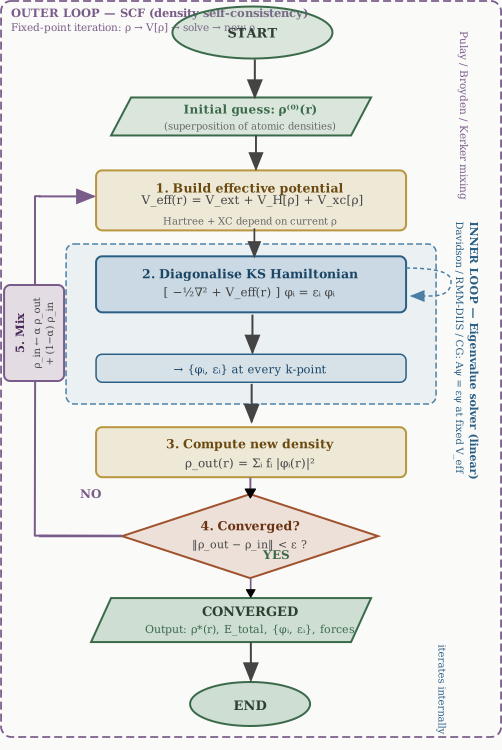
Figure 3.1. The DFT SCF cycle. The outer loop (purple dashed border) implements density self-consistency: a non-linear fixed-point iteration \(\rho = F[\rho]\) accelerated by mixing schemes. The inner loop (blue dashed border) implements the linear eigenvalue solver \(\hat{h}_{\rm KS}\phi = \epsilon\phi\) at fixed effective potential, itself an iterative method (Davidson, RMM-DIIS) that builds the eigenspace through matrix-vector products. The two iterations are nested: a typical calculation requires 20–80 outer SCF steps, each invoking the inner solver for 3–8 iterations per \(\mathbf{k}\)-point. The blocks are colour-coded by role: green for initialisation and output, gold for density/potential operations, blue for the eigenvalue solver, plum for SCF mixing, and terracotta for the convergence test.
The details of the mixing algorithms in step 6 and the inner eigenvalue solver in step 3 are sufficiently involved that they receive their own chapters: Chapter 8 develops density mixing schemes (linear, Kerker, Pulay/DIIS, Broyden), and Chapter 10 develops iterative diagonalisation (Davidson, RMM-DIIS, conjugate gradients).
Physical Meaning of Kohn–Sham Quantities
It is crucial to understand what the KS framework does and does not claim to represent physically.
The Total Energy
The total ground-state energy is not simply the sum of the KS orbital energies. Summing the eigenvalues gives:
Substituting the definition of \(V_{\mathrm{eff}}\):
Comparing this to the exact total energy \eqref{eq:KS-energy}, we see that the Hartree and XC interactions have been double-counted in the eigenvalue sum. The correct total energy must be reconstructed by subtracting the double-counting terms:
The KS Orbitals and Eigenvalues
In exact DFT, the fictitious KS orbitals \(\phi_i\) and their energies \(\epsilon_i\) have no strict physical meaning, with one exception: the highest occupied KS eigenvalue equals the negative of the first ionisation energy of the exact many-body system:
This IP theorem was established independently by Almbladh and von Barth (1985) and Levy–Perdew–Sahni (1984) using the asymptotic form of the exact density at large \(|\mathbf{r}|\). The result is not a direct consequence of Janak’s theorem (Janak 1978), which states the distinct identity \(\epsilon_i = \partial E/\partial f_i\) (the KS eigenvalue is the derivative of the total energy with respect to its occupation number). Janak’s theorem applied at integer \(N\) gives the chemical potential, and combined with the long-range behaviour of the exact density yields \(\epsilon_{\rm HOMO} = -I\); both ingredients are required.
The other eigenvalues \(\epsilon_i\) do not formally correspond to electron removal or addition energies (quasiparticle excitations). The KS “band gap” (\(\epsilon_{\mathrm{LUMO}} - \epsilon_{\mathrm{HOMO}}\)) systematically underestimates the true fundamental gap, even if the exact XC functional were used. This is due to the derivative discontinuity of the exact XC functional with respect to particle number.
Despite this, KS orbitals and eigenvalues are widely (and somewhat informally) used to interpret band structures, density of states, and orbital energies, and often agree qualitatively with experiment, but this agreement is not guaranteed by the theory.
Formally correct excitation spectra require going beyond ground-state DFT, e.g. via Time-Dependent DFT (TDDFT) or many-body perturbation theory (GW approximation).
Summary
The Kohn–Sham scheme reduces the interacting many-body problem to a set of effective single-particle equations \eqref{eq:KS-eqn} that can be solved efficiently on modern computers. The key steps and ideas are:
| Concept | Role |
|---|---|
| Non-interacting reference system | Enables exact computation of \(T_s[\rho]\) via orbitals |
| \(V_{\mathrm{H}}\) | Classical mean-field Coulomb repulsion, computed exactly |
| \(V_{\mathrm{xc}}\) | All many-body quantum effects, must be approximated |
| SCF loop | Resolves the self-consistency between density and potential |
| XC approximation (LDA, GGA, …) | The only uncontrolled approximation in the KS framework |
The formal exactness of the KS framework — all errors traceable to a single approximated term — combined with its single-particle structure makes DFT the workhorse of electronic structure theory. In the chapters that follow, we will examine how this framework is implemented in practice: basis sets, pseudopotentials, \(k\)-point sampling, and the computational details of solving the KS equations for real materials.