Monte Carlo Methods for Physicists: Lecture Notes
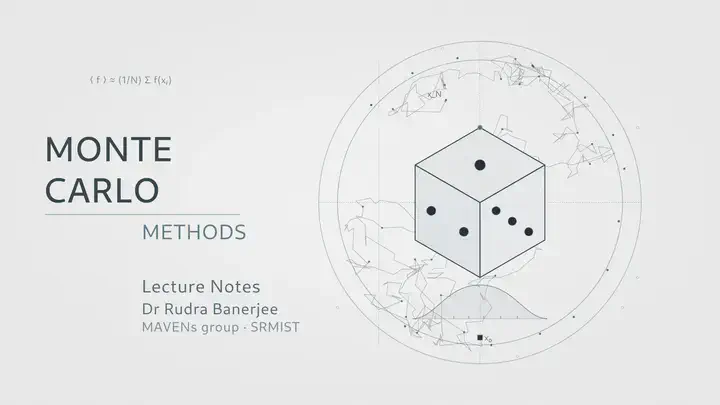
Monte Carlo (MC) methods are among the most broadly applicable computational techniques in all of physics and physical chemistry. They are used to study phase transitions in magnetic materials, compute free energies of proteins, simulate particle detector responses, model surface catalysis, and sample posterior distributions in data analysis. This course develops both the theoretical foundations and the practical computational skill needed to apply MC methods to real research problems.
Course Syllabus
This course introduces Monte Carlo methods from first principles, moving systematically from the mathematics of probability and sampling to large-scale simulations of interacting many-body systems. The 15 classes are organised into 9 chapters, balancing rigorous derivations with hands-on Python labs.
Part I: Foundations
We begin with the probabilistic and algorithmic bedrock of Monte Carlo methods, building up the machinery needed to generate, transform, and integrate random variates.
- Foundations of Probability & Randomness
- Sampling Methods
- Monte Carlo Integration
- Markov Chain Monte Carlo (MCMC)
Part II: Statistical Mechanics & Applications
Theoretical machinery comes alive when applied to interacting systems. The second half of the course uses MC to probe phase transitions, free energies, and non-equilibrium dynamics in canonical models of condensed matter and chemical physics.
- The Ising Model & Statistical Mechanics
- The Heisenberg Model & Classical Spin Systems
- Advanced MCMC & Free Energy Methods
- Kinetic Monte Carlo
- Applications, Error Analysis & Special Topics
Meet Your Instructor
Rudra BanerjeePrerequisites
Participants should be familiar with:
- Thermodynamics and Statistical Mechanics at the undergraduate level
- Basic Quantum Mechanics (helpful but not required)
- Elementary probability theory and linear algebra
- Basic programming in Python
No prior knowledge of stochastic methods is required.
Course Objectives
By the end of this course, participants will be able to:
- Understand the theoretical foundations of Monte Carlo methods and stochastic sampling.
- Implement and analyze the Metropolis–Hastings algorithm and other MCMC techniques.
- Simulate canonical statistical mechanics models including the Ising and Heisenberg models.
- Apply advanced methods such as Wang–Landau sampling, parallel tempering, and free energy perturbation.
- Model non-equilibrium dynamics using Kinetic Monte Carlo (KMC).
- Perform rigorous error analysis and quote statistically meaningful results.
Target Audience
This computational physics course is designed for:
- Graduate students and postdocs in Physics, Chemistry, and Materials Science.
- Experimental researchers wanting to add stochastic simulation to their toolkit.
- Anyone interested in mastering computational statistical mechanics and Bayesian inference.